
Venezuela: Machado back from exile, Europe must guarantee a transition that is not decided in Washington alone
Nobel Peace Prize laureate and leading opposition figure María Corina Machado returned to Caracas on Sunday, cheered by thousands of supporters. Excluded from the talks sponsored by Washington, she says she is ready for dialogue with interim president Delcy Rodríguez, who mocked her return as a "show".
Translation of an article originally published in French. Read in French
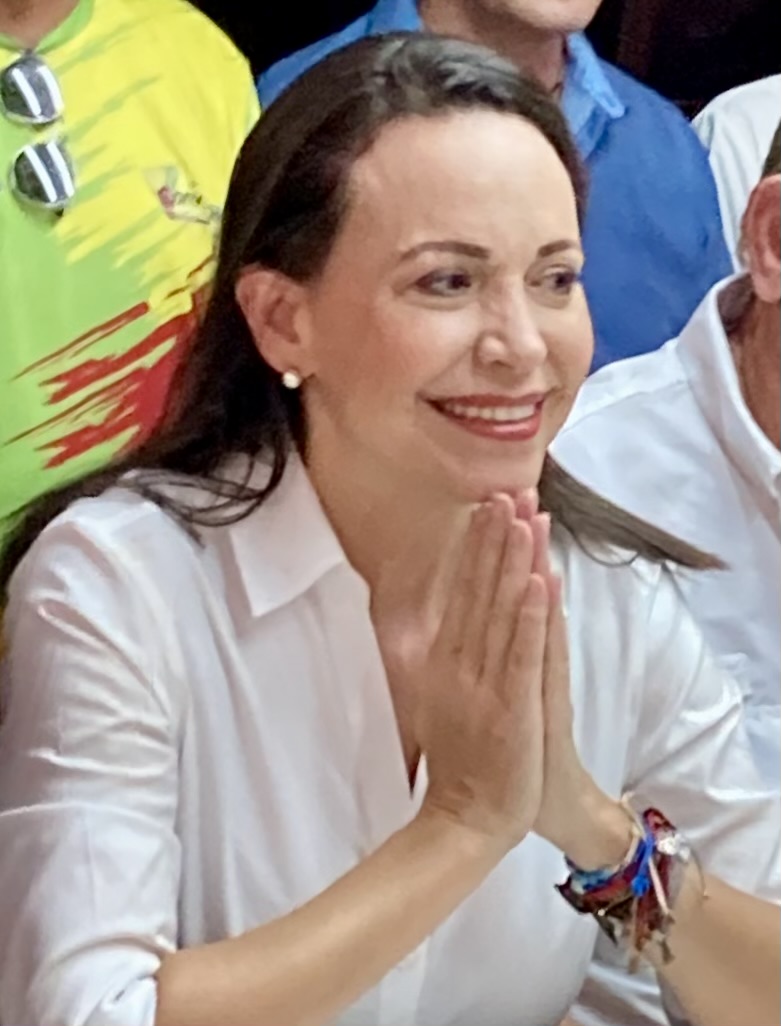
María Corina Machado returned to Venezuela on Sunday, October 25, after nearly a year in exile. According to RFI, thousands of supporters accompanied her over some 400 kilometres, from Barquisimeto to Caracas, where she arrived during the night. Winner of the 2025 Nobel Peace Prize and the leading figure of the opposition, she nonetheless remains excluded from the transition talks that Washington has sponsored since the US military captured Nicolás Maduro last January.
The facts
As reported by Euronews and the AP news agency, María Corina Machado secretly left the country in December 2025 to receive her prize in Oslo. According to her party, Vente Venezuela, she reportedly tried to return at least seven times without success. She settled in Panama during her exile. Her return route has not been made public; pro-opposition media mention a passage through Colombia, according to RFI.
The country is run on an interim basis by Delcy Rodríguez, Nicolás Maduro's former vice-president, who came to power with Washington's backing. Part of the opposition, led by Dinorah Figuera, is negotiating an overhaul of the institutions with her. According to Reuters, a State Department official said on Monday that these talks should produce a new Supreme Tribunal of Justice by the end of the year, followed by a new National Electoral Council. No election date has been set. The Machado camp is calling for a presidential election in 2027 and for its leader to be allowed to run, which she was denied in 2024.
The positions at stake
The Machado camp says it is ready to talk. Her spokesperson, Claudia Macero, said on Unión Radio that the opposition leader was willing to meet Delcy Rodríguez, with transparency and a precise agenda. According to RFI, she believes no credible transition is possible without her.
The interim president responded more curtly. According to the Colombian daily El Tiempo, she said this return could have avoided the "show", while acknowledging that it will be necessary to sit down with Machado to reach agreements on elections. Diosdado Cabello, interior minister and head of the Chavista party, said he was not afraid of her, RFI reports.
Washington is taking a cautious line. According to Reuters, Secretary of State Marco Rubio said Venezuela's electoral system had been designed to rig elections and had to be replaced before any valid vote. He added a warning:
If anybody tries to derail that process, they're doing a great harm to Venezuela — Marco Rubio
Marco Rubio says he asked the interim authorities to let the opposition leader return unhindered. Donald Trump, for his part, said he had not been informed of her return, while claiming that everything is going very well in Venezuela, according to Euronews.
The European Union welcomed her return. Its spokesperson, Anouar El Anouni, sees it, according to RFI, as an "opportunity" to open up political space towards free and fair elections.
The analysis
Supporters of the American approach deserve credit for one serious argument: after the 2024 presidential election, whose official results were widely disputed, holding a vote without first reforming the judiciary and the electoral authority would risk reproducing the same suspicions. A negotiated transition, even an imperfect one, can prevent the collapse of the state in a country already hit, according to El Tiempo, by a double earthquake in June.
But a transition that sidelines the main opposition figure raises a problem of legitimacy. According to the AP, cited by Euronews, the repression that followed the 2024 presidential election left 28 dead and more than 2,400 detained. Entrusting the overhaul of the institutions to the regime's former number two, under Washington's sole arbitration, with no electoral timetable, means running the risk of a democracy under tutelage.
The other shadow over the picture is oil. Venezuela holds the largest proven reserves in the world. According to Euronews, Delcy Rodríguez has given the United States access to a significant share of its crude and signed agreements with foreign groups. Reuters notes that critics accuse Donald Trump of a neo-colonial approach. One may not share that word and still worry about a transition in which contracts seem to move faster than the ballot box.
For France and Europe, the stakes go beyond Latin America. International law and the sovereignty of peoples are not principles to be applied selectively: they cannot be invoked in Ukraine and ignored in Caracas. Europe is also home to a large Venezuelan diaspora, particularly in Spain, and has every interest in lasting stabilisation rather than a mere sharing out of resources.
Conclusion
The Gaullist tradition has always defended an independent diplomacy, able to talk to everyone without aligning with anyone. Now is the time to apply it. France could propose, with its European partners, that the Union act as guarantor of a public electoral timetable and of independent observation of the future vote, in conjunction with the UN. One question remains open: will Washington accept that a free vote might produce a result it does not like?
Article written with the help of artificial intelligence.
The author
La Rédaction LSR — La rédaction de LSR Media.